Halo, Aureola and Glory in Art and fashion.
So what do you think of the use of these religous symbols in fashion (lolita or not)? Do you think it's outrageous or would you wear halos, or maybe do you already have one?
Victorians and the aesthetic myth of children's purity.
After a very long hiatus, I'm back with a new article. This time, I would like to address a very controversial subject which is how most Victorians upper-class poets, artists, men (mostly) regarded children. I'm no specialist on the subject and I only did a pretty light research, moreover it seems that scholars are still questioning the ambiguous relationship many Victorian artists had with young children. To put it in a nutshell, just consider this article as a summary of what I could gather on the subject by reading some essays on the subject.
 "Heaven lies about us in our infancy!"
Most of you might have heard of Victorian children either through Lewis Carroll's
Alice's adventures in Wonderland, James Barrie's
Peter Pan or Charles Dickens' numerous novels. You might also know that during queen Victoria's long long reign over the British Empire, the number of children among the global UK population increased a lot, so queen Victoria was actually ruling over an average population composed of more than 1/3 of children under the age of 15. Many children had to work in factories or coal mines, which resulted in an increased child mortality rate (check Dickens' novels about working children, he knows what he's writing about as he, himself was sent to work in an infamous workhouse when he was a child).
But as many Victorians did not seem to mind the fact that children, sometimes under the age of 5, were working in factories, an increasing number of men and women seemed to consider childhood as a "sacred" or "golden" age. It seems that many Victorians revered children as innocent and pure and "unspoiled" beings who should be preserved and whom you enjoyed the company as a distraction from the ugly practical world and the stress, the quick industrialization of the country was putting on the Victorians' shoulders.
But even if Victorians seem to consider children as free from the constraints of their "materialistic" society as one can be, it seems that anything and everything (ranging from teacups to calendars, clothing and magazines) featuring children used to sell out very quickly. And stage plays featuring children used to be very popular as well even if in most of them, children were mostly used as "props" in the background and not acting properly.
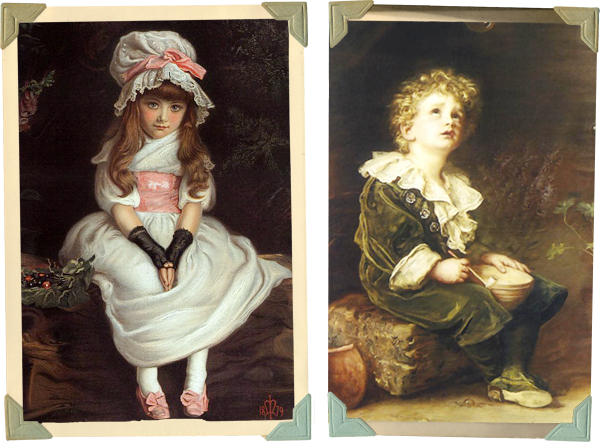
Millais' "Cherry Ripe" (1879) and "Bubbles" (1886) were used by the Pears Soap Company on their boxes
 "The cult of the Child"
The most controversial Victorian adult/child relationship to this day surely is Charles Lutwidge Dodgson (a.k.a. Lewis Carroll) and little Alice Liddell's one. After visiting an exhibition of Dodgson's photographic works in New-York, Vladimir Nabokov is reported to have said there was “a pathetic affinity” between the photographer and the pedophilic narrator of his novel
Lolita... So was Lewis Carroll somebody you would not want children to get close to?
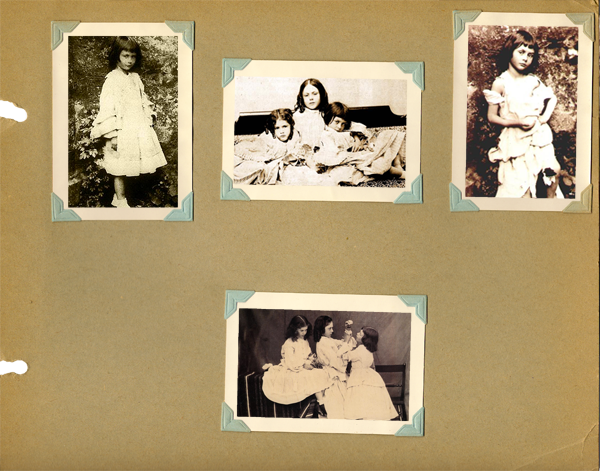
Some of the photos Dodgson took of the Liddell sisters (Lorina, Edith and Alice).
Charles Lutwidge Dodgson was a photography hobbyist. He took many photos throughout his life many of them seem to feature young children, especially girls, mostly his friends' or colleagues' children. The nature/subject of these photos coupled with writings taken from his diary and letters apparently became a subject of concern among some scholars.
The fact that Mrs Liddell, mother of Edith, Lorina and Alice coldly asked Dodgson to stop seing her children without supervision further fuels the idea that Dodgson must have had "impure" thoughts regarding the Liddell girls. The fact that a large part of his diary and many of his photos seem to have been voluntarily destroyed and that his family always declined interviews and to say anything about him even after his death rose a flag of suspicion over Dodgson's relationships with little girls, especially Alice Liddell, his favorite.
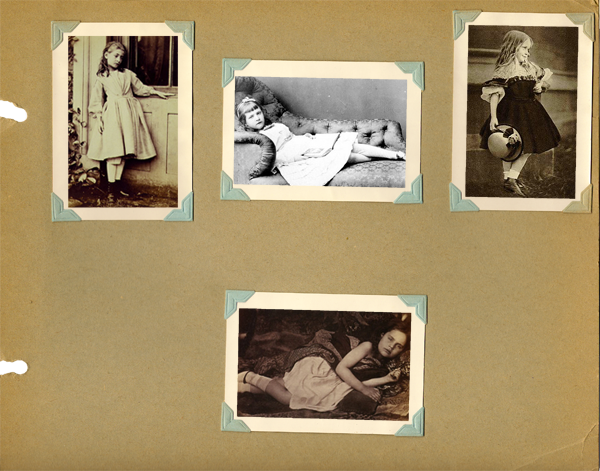
Other photos taken by Dodgson of the young girls he used to call his "child friends".
If we consider what I wrote above, it was not unusual for Victorian grown men and women to enjoy the view and company of children. And contrary to some of his contemporary fellow artists, Dodgson never acted on his aestetic tendency to enjoy the company and the view of little girls even if some of his writings might make our 21st century selves a bit "unconfortable". But it seems that most Victorians considered children as "asexual" beings, experiencing neither lust nor carnal desire. So even if Dodgson's feelings towards little girls might have been "impure" from our point of view, they were not especially considered as such in his times and he never seemed to have actually molested any child.
Ernest Dowson for instance wrote many sonnets about little girls and even proposed to one of them when she was barely 14...
Further reading -
The Victorian child c.1837-1901 by Marah Gubar from the University of Pittsburgh.
-
Lewis Carroll's shifting reputation by Jenny Woolf.
-
The Victorian cult of the child from Plan Elfenbeinturm
-
Lewis Carroll a myth in the making from the victorianweb.
-
Victorian Children, a look into the life and times of Victorian children.
-
Photographs of Alice Liddell, the inspiration for Alice in Wonderland.
Libellés : art and litterature, history
Quel rêve, ô pauvre Folle !
Among Shakespearian ladies, Ophelia has always been my favourite. Mostly because Ophelia who first appears as the human incarnation of goodness and purity, so childlike and naïve, slowly falls into what the other characters of Hamlet consider as insanity : handling flowers she had gatherd in the folds of her dress to the courtesans and singing songs ; which eventually leads to her doubtful death by drwoning.
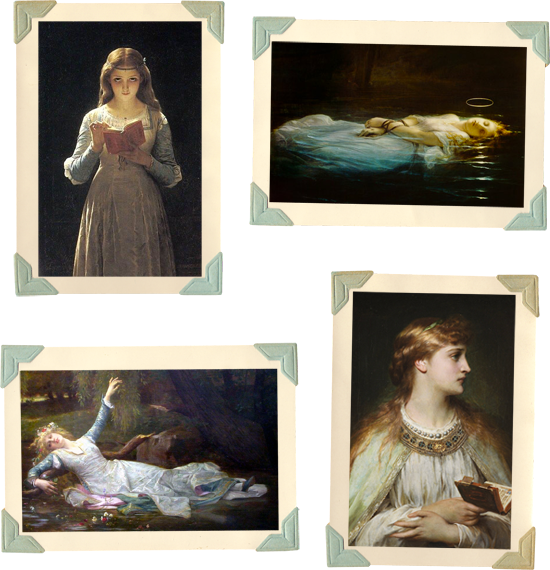
- Ophelia by Cot, Dicksee, Cabanel + not very Ophelia but much alike Paul Delaroche's "The young martyr" -
 "Et l'Infini terrible éffara ton oeil bleu !"
The title I used is taken from Arthur Rimbaud's poem "Ophélie" that you can read below :
"Sur l'onde calme et noire où dorment les étoiles
La blanche Ophélia flotte comme un grand lys,
Flotte très lentement, couchée en ses longs voiles...
- On entend dans les bois lointains des hallalis.
Voici plus de mille ans que la triste Ophélie
Passe, fantôme blanc, sur le long fleuve noir
Voici plus de mille ans que sa douce folie
Murmure sa romance à la brise du soir
Le vent baise ses seins et déploie en corolle
Ses grands voiles bercés mollement par les eaux ;
Les saules frissonnants pleurent sur son épaule,
Sur son grand front rêveur s'inclinent les roseaux.
Les nénuphars froissés soupirent autour d'elle ;
Elle éveille parfois, dans un aune qui dort,
Quelque nid, d'où s'échappe un petit frisson d'aile :
- Un chant mystérieux tombe des astres d'or"
- Arthur Rimbaud, "Ophélie", Le Reliquaire, 1891.
Was Ophelia really insane ?! For some scholars, Hamlet, by his actions and words slowly drive Ophelia, the one he once loved, into madness as in his twisted mind, women are all bound to be harlots, hiding behind the guise of purity, repressed sexual desire and dark intentions.
On that account, Ophelia would be a perfect illustration of hysterical fits in Freud's psychiatric explanation of hysteria as a mental disease caused by repressed sexual desire. Shedding the psychiatric light on Ophelia, 19th century psychiatrists used her as a perfect illustration of hysteria or mental breakdown many young girls experience during adolescence.
Or does Ophelia use her so-called "madness" as a way to express her true feelings and sorrow, saying things she could not have been allowed to say, as a respectable woman in a patriarcal society ? Hence escaping the role the men who surround her: her father, Hamlet and her brother seem to confine her in : a "tool" for her father, both a loved-one and a subject of hate and disgust for Hamlet and the epitome of purity for her brother. All of them using her, having ulterior motives and an agenda of their own.
Insane or not, Ophelia seems to be meaningful for
Pre-raphaelites painters. Ophelia's madness and tragic death seems to be a source of inspiration for many 19th century painters.
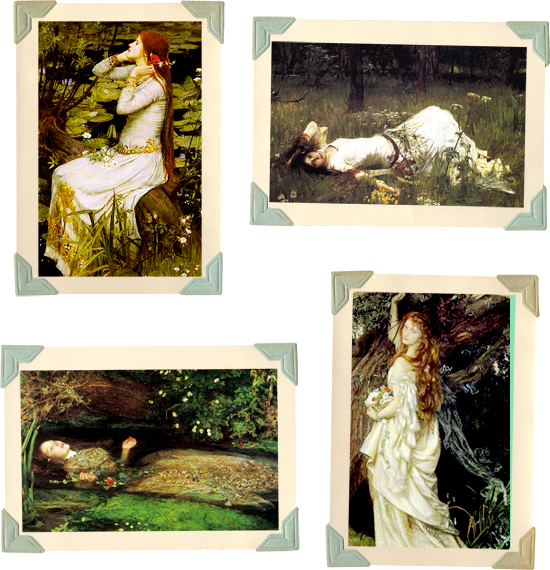
- Ophelia by Waterhouse, Millais and Arthur Hughes -
Elizabeth Eleanor Siddal, the Pre-raphaelites' Ophelia :
The most famous Pre-Raphaelite Ophelia definitely is
Millais' Ophelia. Despite mixed reviews when it was first displayed in 1852 at the Royal Academy in London, Millais' Ophelia is his most famous painting.
Millais used then 19 years old
Elizabeth Eleanor Siddal as a model for his Ophelia. He painted the landscape first and then had miss Siddal pose for long hours in a bathtub filled with water. Miss Siddal caught a cold and her father threatened to sue Millais as he held him responsible for her daughter's disease. Millais agreed to pay the doctor's bill and as miss Siddal recovered from her cold, everything was amiably settled.
Let me tell you more about Lizzie Siddal. She was born in 1829 and died in 1862. Her life story is both captivating and sad. She was born in an "upper class" labourer's family. Lizzie started to work for a milliner and she was spotted by the painter
Deverell who used her as a model and introduced her to the Pre-Raphaelites. So she became one of the most famous Pre-Raphaelite model.
She especially caught
Dante Gabriel Rosetti's interest in 1849 and she started modelling exclusively for Rosetti. They started then started a pretty complicated : Lizzie spent long hours at Rosetti's place, which, in 19th century Great-Britain meant that she could not marry a respectable man as she was considered as Rosetti's mistress. The problem is that Rosetti could not make his mind and it took him 10 years to finally propose to Elizabeth.
Elizabeth was very anxious over this relationship which was the cause of her ill-health. She fell into severe depression, being often very ill and using her ill-health as a mean to keep Rosetti close. Having many fits of melancholy and refusing to eat anything when she was afraid he might leave her and fall for a younger and prettier muse.
Lizzie was also addicted to
laudanum, a mix of alchohol and opium which was prescribed by doctors to cure everything back then. She died of an overdose of laudanum in 1862. Her death was ruled as accidental but it actually was a suicide. Rosetti who discoverd her dying wife found a suicide note he burned before calling the doctors. As suicide was considered as shameful and would have bared Lizzie from a Christian burial.
Elizabeth was an artist herself. She wrote
poems and
painted and did several sketches. Ruskin, a Pre-Raphaelite brotherhood supporter, encouraged Lizzie to pursue a carreer in art. But her undecisive husband Dante Gabriel Rosetti's works unfortunately overshadow Lizzie's artistic productions.
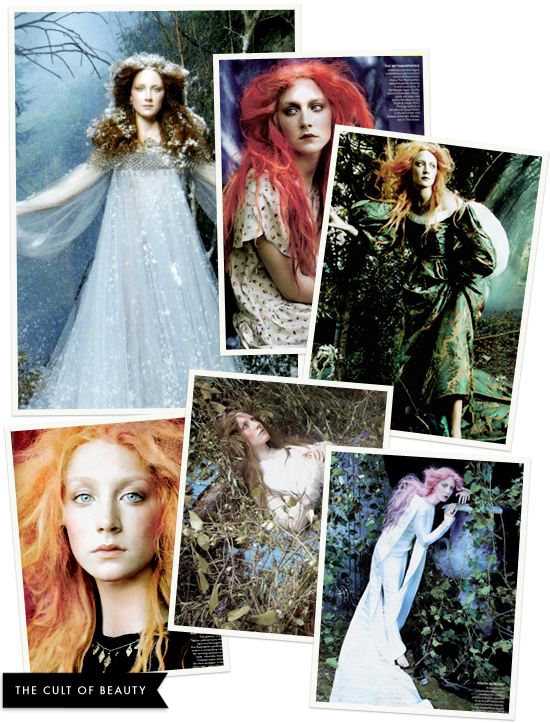
- Steven Meisel, "The cult of beauty" for Vogue US (2011) -
Libellés : art and litterature, history
La belle au bois dormant / Sleeping Beauty
As my blog layout is currently Sleeping beauty-themed I though I'd start my fairytales-related entries with that one. You probably know Disney's take on Sleeping Beauty but it's a seriously toned-down and "soft" version of this famous fairytale.
 Origins and alternative versions of the tale
There are many similarities between a French 14th century tale called
Perceforest. It's also believed that
Il Pentamerone (1636) contained an early version of "Sleeping Beauty" which strongly influenced
Charles Perrault's famous tales. The Grimm brothers published another version of Sleeping Beauty:
Briar Rose which is VERY tame and which I belived is the version used for Disney's movie and the one most people heard of: at the end of the tale, the Prince kisses the sleeping princess awake (and they live happily ever after)...
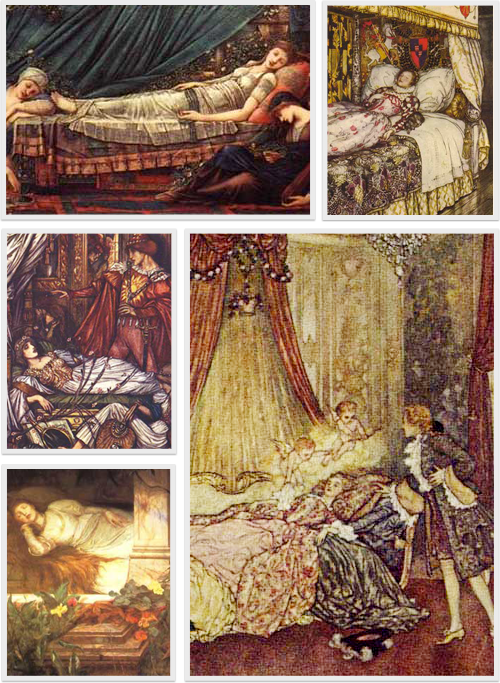
Illustrations by Edmond Dulac, Arthur Rackham, Edward Frederick Brewtnall, Edward Burne-Jones, Herbert Cole
First of all, Perrault did not write for children, like La Fontaine's well-knowed
Fables they were just a way to avoid censorship and to send messages to the nobility living at king Louis XIV's court. Hence Perrault's tale does not stop when the sleeping princess wakes-up.
After the princess wakes-up, she marries the prince and they have several children. But the prince's mother actually is an ogre and while the prince is away she asks her cook to kill every one of her grand children and cook them for dinner. The cook who does not have the courage to kill the innocent children, instead hide them and gives fawns to the ogre. But she's still not satisfied and asks the cook to kill her daughter-in-law and cook her for dinner. The cook who's a good man decides not to kill the princess and hides her and gives the old queen some deer for dinner.
But some day, as the princess and her children are playing, hidden in the cook's house, the old queen hears them and have them brought. She then decides not to eat them but to throw them in a pit filled with snakes. But as she intends to do so, the prince comes back from war or whatever he was away for... And in rage and fear of punishment, the old queen jumps in the pit and dies. THE END. This version is pretty dark as cannibalism is a theme which has been often forgotten in most children's books.
Alternative version of Sleeping Beauty (NSFW)
In other older and alternative versions of the tale, as in
Perceforest, the prince discovers the sleeping princess while hunting in the woods. He falls in love with her and then instead of trying to wake her up, he just rapes her. Yes, he rapes her in her sleep and he comes back several time, not telling anyone what/who lied in the midst of the woods. The princess soon gets pregnant and gives brith, still not waking-up. But her child getting hungry grabs one of her mother's finger and starts sucking on it hence removing the pin which had condemned her to eternal slumber. The princess then woke-up and the prince who had come to the woods again discovers the princess awake with their child and decides to marry her (how convenient)!
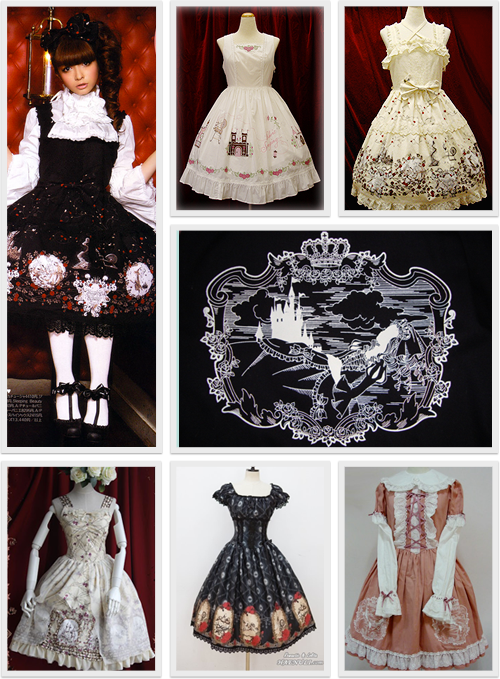
Sleeping Beauty used in lolita: Bssb, Angelic Pretty, Hanuli and Infanta
Sleeping Beauty in other media
As seen above,
Sleeping beauty has been used in lolita several times by differnt brands and is a reccurent theme as many other fairytales (Juliette et Justine also made a
Rpbe de la belle au bois dormant).
You might also have heard of the ballet based on
Sleeping Beauty. The music was composed by
Tchaikovsky and the choregraphy created by
Marius Petipa. Disney's movie uses some of Tchaikovsky's music in their animated movie. The ballet is pretty famous and the part of Princess Aurora is quite a challenge for dancers, especially its
Rose adagio which is one of the most difficult variation.
Edward Burne-Jones made a several paintings based on
Sleeping beauty: "
The legend of Briar Rose". Each panel comes with a poem written by
William Morris.
Sleeping beauty is also sometimes used as a motif in fashion editorials even if it's not the most used fairytale in fashion (see below).
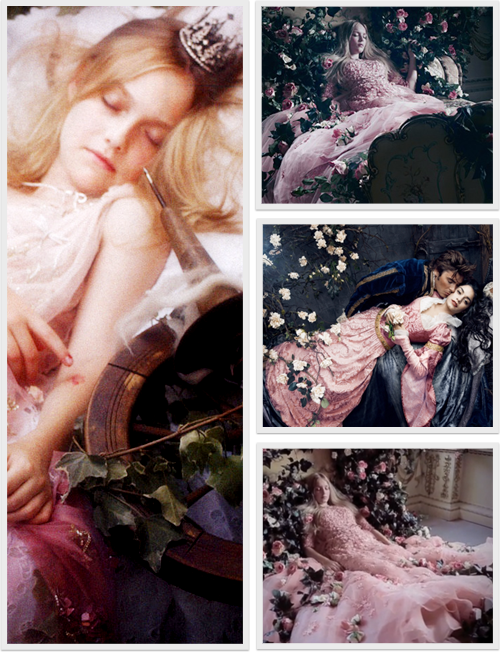
Credits: Dakota Fanning by Karl Lagerfeld, Ad for Harrods by Patrick Naik, Annie Leibovitz for Disney
Libellés : art and litterature, fairytales, fashion, lolita, music and ballet
Halo, Aureola and Glory in Art and fashion.
Halos seem to be a new trend among lolitas. I don't exactly know what was the origin of this trend. But religious themes have been used a lot in fashion editorials for quite a long time.
I decided to "research" the subject and I thought it might be interesting to share the knowledge I gathered about halos, aureolas and glories.
 Aureola / Halo
Comes from the Latin adjective
aureus which means "golden". It's usually a golden disk or circle which surrounds the head (or sometimes the whole body) of a religious figure. At first it was a pagan symbol used by the Egyptians, Greeks and Romans to symbolize divinity or spiritual power, which was later assimilated into Christian art.
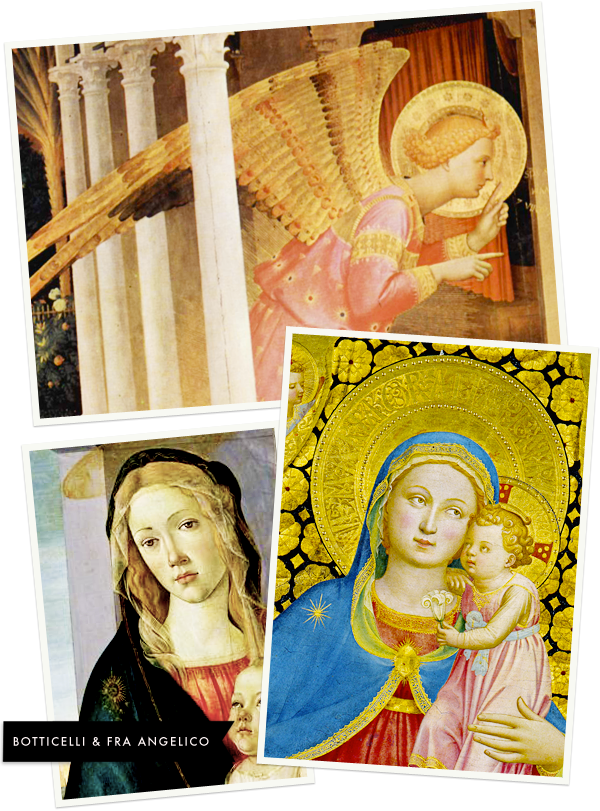
Some examples of halos used in Christian art.
You might notice that Botticelli (on the left) introduced perspective: the halo is now hovering over the heads of the saints.
Glory
Comes from the Latin adjective
gloria which means "fame". It takes the shape of rays of light surrounding the head of a saint. It's a Christian symbol it denotes the manifestation of God's presence. Glory and halos are often confused.
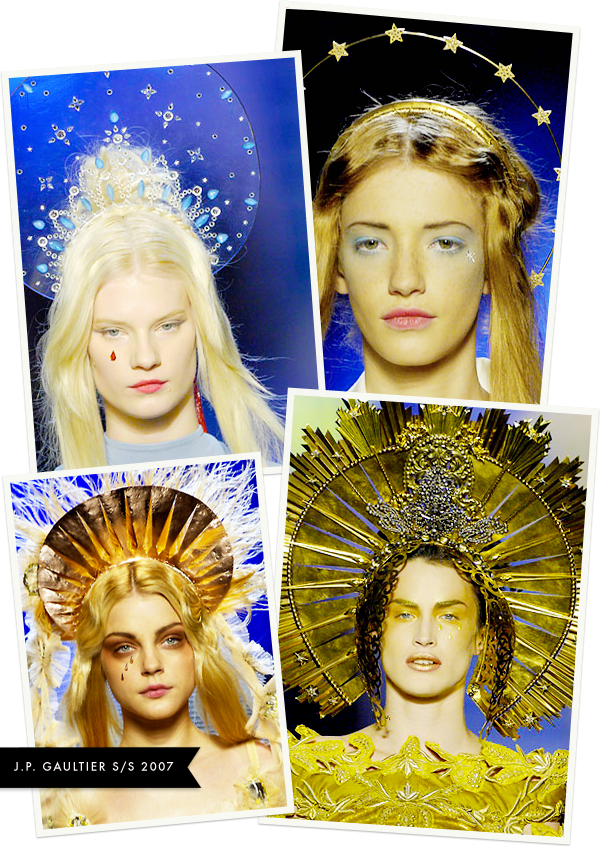
Very famous use of "Glory" and "Halos" in Fashion.
Jean Paul Gaultier's S/S 2007 collection.
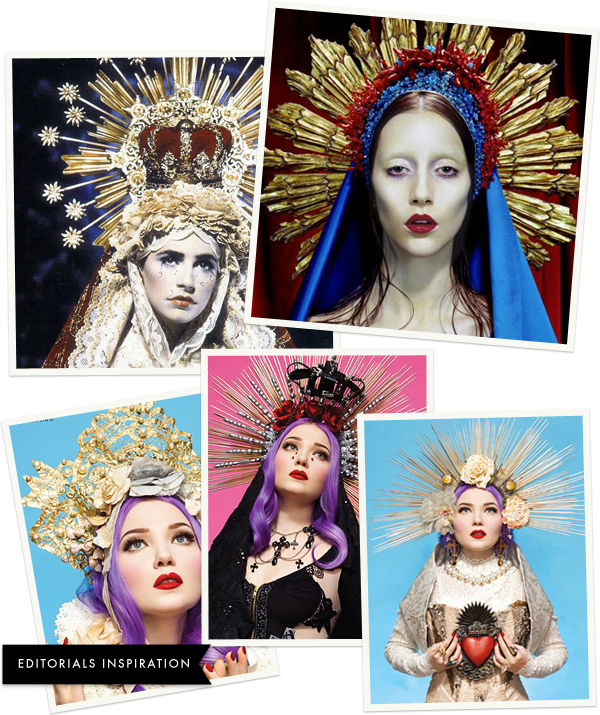
Other examples of glories and halos used in fashion editorials.
Pierre et Giles - Miles Aldridge - Jason Setiawan
So what do you think of the use of these religous symbols in fashion (lolita or not)? Do you think it's outrageous or would you wear halos, or maybe do you already have one?
Libellés : art and litterature, fashion, lolita, religion












 평화 [pʰjəŋ.hwa]