Halo, Aureola and Glory in Art and fashion.
So what do you think of the use of these religous symbols in fashion (lolita or not)? Do you think it's outrageous or would you wear halos, or maybe do you already have one?
Beauty is only skin deep
Beauty ideals evolved a lot through the course of history. For instance, a woman considered "beautiful" nowadays would have been deemed as "ugly" according to the 17th century standards when being "plump" was a sign of good health and "pale", a sign of nobility and wealth.
I don't pretend to write a very elaborate entry about the evolution beauty ideals through the ages as whole books have been written on the subject already. But I just wanted to share some of my discoveries concerning make-up and generally "crazy" and unealthy things women would do for the sake of being considered "beautiful".
 Antiquity beauty ideals
Light skin has almost always been considered beautiful as it was a sign of your rank in society (only the ones who had to work to earn their living had tanned kin) and it was indeed the case in Greek/Roman/Egyptian times. To make their skin look whiter/paler, women used foundation made of a mix of fat, oil and white lead or Venetian ceruse.
The problem is that lead and ceruse are highly toxic and can cause very heavy damage to your body, causing among other health hazards: scars, damage to your nervous system, brain disorders and plain blood poisoning due to the accumulation of lead in your body through your skin.
Middle Ages & Renaissance beauty ideals
Pale skin was a must for noble ladies (just as it was before). Showing your hair and applying makeup were considered "sinful" and associated with prostitutes and actresses. But noble and wealthy women sometimes used foundation mixed with mercury (another highly poisonous metal). And some went so far as to bleed themselves to appear paler! Medieval women would also pluck or shave their forehead and eyebrows to widen their brow as it was considered beautiful.
Agnès Sorel, mistress of French king Charles VII, was considered as the most beautiful lady of her times (see below, bottom right picture) and she died of Mercury poisoning after giving birth. Some considered she had been vonluntarily poisoned but it rather seems that she ingested a lot of heavy metals during her life such as mercury or gold which were considered to be good for health and beauty (which was indeed not the case).
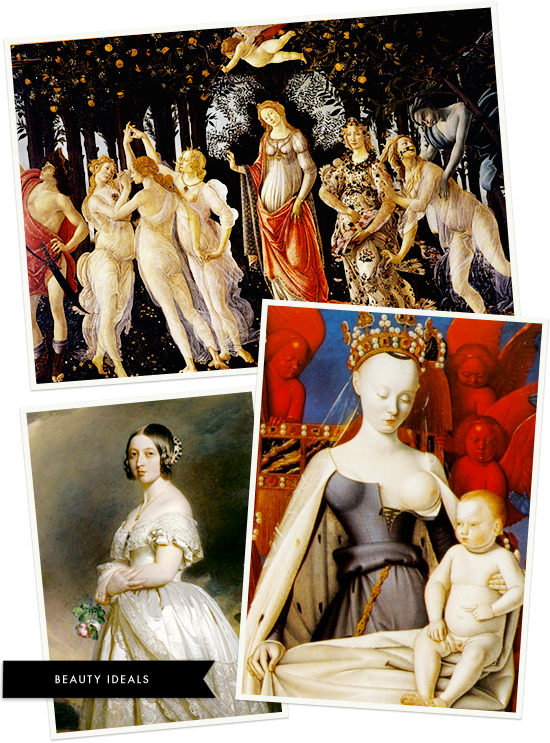
Beauty ideals during Renaissance (Primavera), Middle Ages (Agnès Sorel) and Victorian era (queen Victoria)
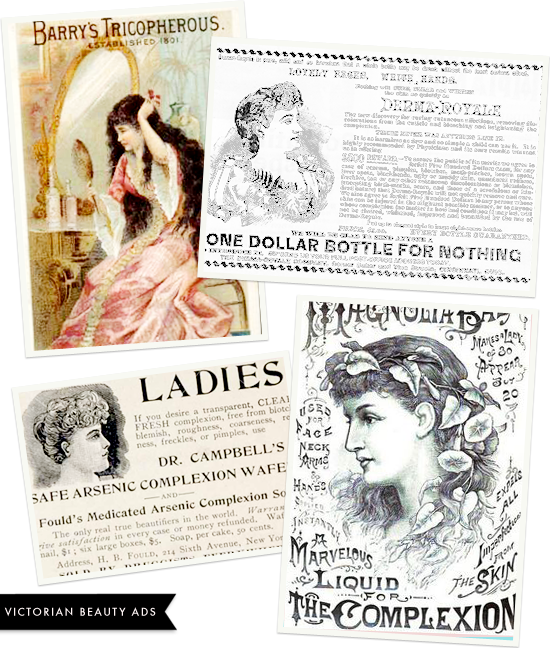
Pale skin is still a must. As you can see in the Victorian ads below, most of the foundation used during the Victorian era was highly poisonous, mixing arsenic, mercury with lead. The use of these poisonous mix raised concern among the medical community as it caused some women's death!
Dilated pupils were also considered as beautiful and attractive, so women used belladonna drops to make their pupils bigger but it caused visual distortion, increased heart rate and even blindness if used regularly.
Interesting links to learn more about beauty ideals
-
Evolution of corsetry and its impact on health.
-
Suffering for beauty - Killer cosmetics through the ages.
-
Regency cosmetics.
-
History of beauty review of Umberto Ecco's book.
-
Victorian era beauty tips for the lolita.
So, what's your opinion about all of this. Nowadays, women still do pretty "crazy" and unealthy things to appear beautiful (examples:
1 -
2 -
3 and many more...). Any thoughts about this?
Libellés : fashion, history
Dancing is silent poetry (Simonides)
When I was a little girl, one of my dreams was, how original, to become a ballerina, or rather a "danseuse étoile". I was not really conscious of how much work and dedication was behind these two words, I just liked the way they sounded as in my childish mind, it meant that I would someday be able to dance among the stars, I mean litteraly, in the middle of the night sky.
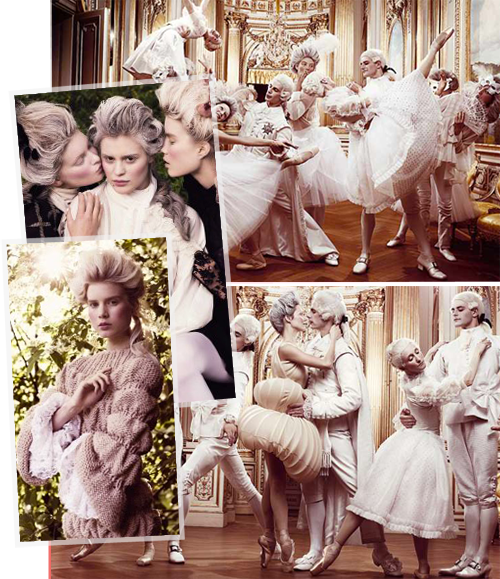
Fashion editorial by ELLE Sweden featuring dancers from the Swedish Royal Ballet
I practiced ballet for a very long time but I'm not a very good dancer, ballet was just the sport I enjoyed the most. What remain from that part of my child and teenage years is a taste for ballet-inspired photos or fashion editorials, a love for tutus, tulle and soft pink and a strange and probably very unhealthy fascination for the instrument of torure called "pointe shoes".
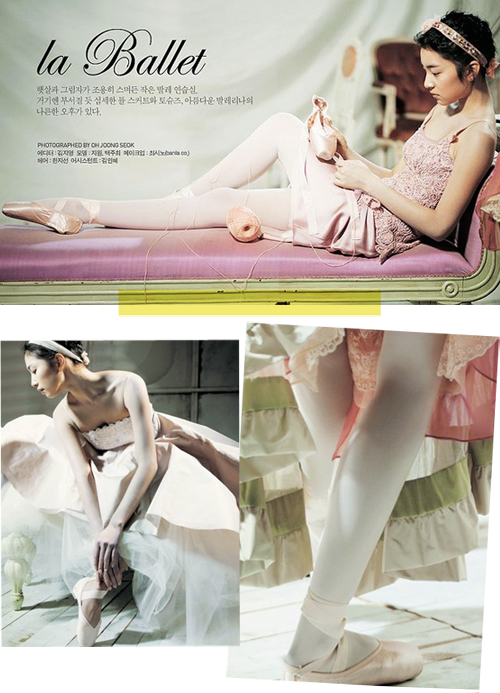
Ballet editorial for Vogue Girl Korea
Luckily for me, I'm not the only one who seems to find ballet-inspired fashion appealing. I suppose you probably heard of the brand Repetto. I remember when my mother first took me to the Repetto shop rue de la Paix in Paris. Back then the shop employees were all wearing dance attire. Today, Repetto still does dance wear but it's mostly known for being a high-street (but pretty expensive) fashion brand.
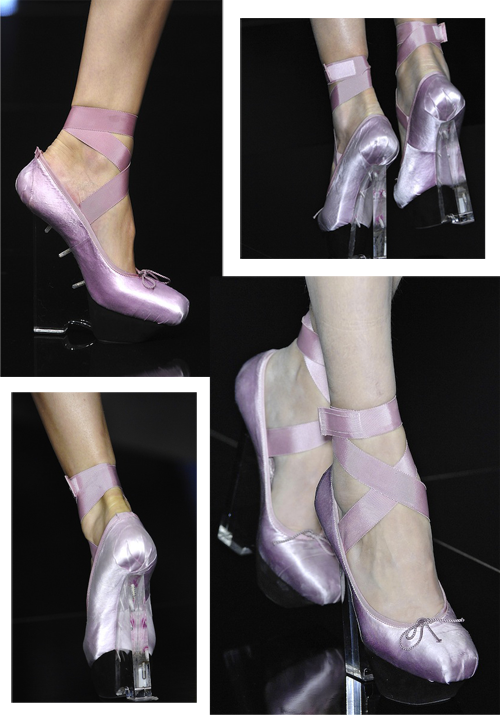
Some ballet-inspired accessories are sometimes used by well-known stylists. Such as the pointe shoes worn by the models for Junko Shimada's spring 2009 collection (see below). The seem to be pretty unconfortable and must be overpriced though.
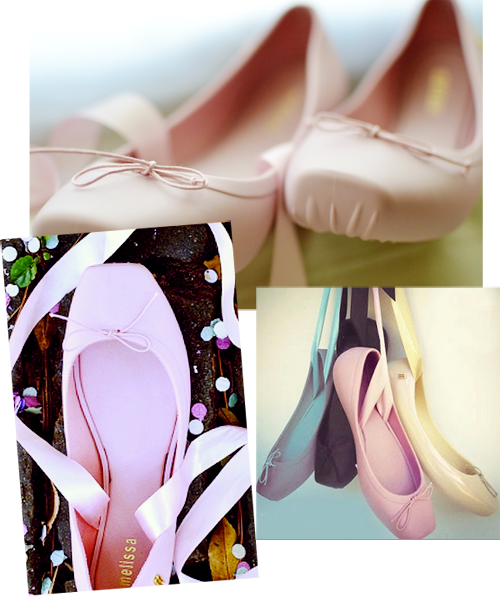
Fortunately for me/us, melissa the famous Brasilian brand released ballet flats which actually look like pointe shoes. And they're pretty affordable (found them going for about £60 on several webstores). They even made a
high-heel version which looks like Junko Shimada's shoes.
Ballet also is a mostif often used in lolita.
Metamorphose,
Bssb, Angelic Pretty (
Ballerina print +
Etoile twins) all made Swan Lake inspired prints and Juliette et Justine released a "
Copelia" dress, a "
Ballerine" and their latest release also is strongly ballerina inspired and named "
robe de ballerine fascinante", even if it's a bit too much of a tutu / "ballerina costume" to be worn as lolita dress in my opinion.
Many lolita shoes are also reminiscent of ballet shoes. Angelic Pretty's tea party shoes for instance or Bssb's "Odette toe shoes" or Alice and the Pirates "Prima shoes" and so on. Not to mention Angelic Pretty's famous ballerina socks.
So, what do you think about ballet-inspired coordinations either in lolita or in other fashion styles? And what's your opinion about the shoes? Would you wear them or is it a "no"?
Libellés : fashion, lolita, music and ballet
La belle au bois dormant / Sleeping Beauty
As my blog layout is currently Sleeping beauty-themed I though I'd start my fairytales-related entries with that one. You probably know Disney's take on Sleeping Beauty but it's a seriously toned-down and "soft" version of this famous fairytale.
 Origins and alternative versions of the tale
There are many similarities between a French 14th century tale called
Perceforest. It's also believed that
Il Pentamerone (1636) contained an early version of "Sleeping Beauty" which strongly influenced
Charles Perrault's famous tales. The Grimm brothers published another version of Sleeping Beauty:
Briar Rose which is VERY tame and which I belived is the version used for Disney's movie and the one most people heard of: at the end of the tale, the Prince kisses the sleeping princess awake (and they live happily ever after)...
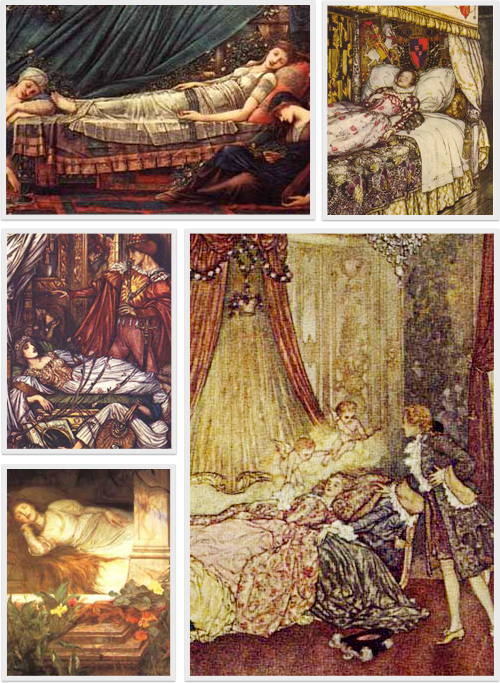
Illustrations by Edmond Dulac, Arthur Rackham, Edward Frederick Brewtnall, Edward Burne-Jones, Herbert Cole
First of all, Perrault did not write for children, like La Fontaine's well-knowed
Fables they were just a way to avoid censorship and to send messages to the nobility living at king Louis XIV's court. Hence Perrault's tale does not stop when the sleeping princess wakes-up.
After the princess wakes-up, she marries the prince and they have several children. But the prince's mother actually is an ogre and while the prince is away she asks her cook to kill every one of her grand children and cook them for dinner. The cook who does not have the courage to kill the innocent children, instead hide them and gives fawns to the ogre. But she's still not satisfied and asks the cook to kill her daughter-in-law and cook her for dinner. The cook who's a good man decides not to kill the princess and hides her and gives the old queen some deer for dinner.
But some day, as the princess and her children are playing, hidden in the cook's house, the old queen hears them and have them brought. She then decides not to eat them but to throw them in a pit filled with snakes. But as she intends to do so, the prince comes back from war or whatever he was away for... And in rage and fear of punishment, the old queen jumps in the pit and dies. THE END. This version is pretty dark as cannibalism is a theme which has been often forgotten in most children's books.
Alternative version of Sleeping Beauty (NSFW)
In other older and alternative versions of the tale, as in
Perceforest, the prince discovers the sleeping princess while hunting in the woods. He falls in love with her and then instead of trying to wake her up, he just rapes her. Yes, he rapes her in her sleep and he comes back several time, not telling anyone what/who lied in the midst of the woods. The princess soon gets pregnant and gives brith, still not waking-up. But her child getting hungry grabs one of her mother's finger and starts sucking on it hence removing the pin which had condemned her to eternal slumber. The princess then woke-up and the prince who had come to the woods again discovers the princess awake with their child and decides to marry her (how convenient)!
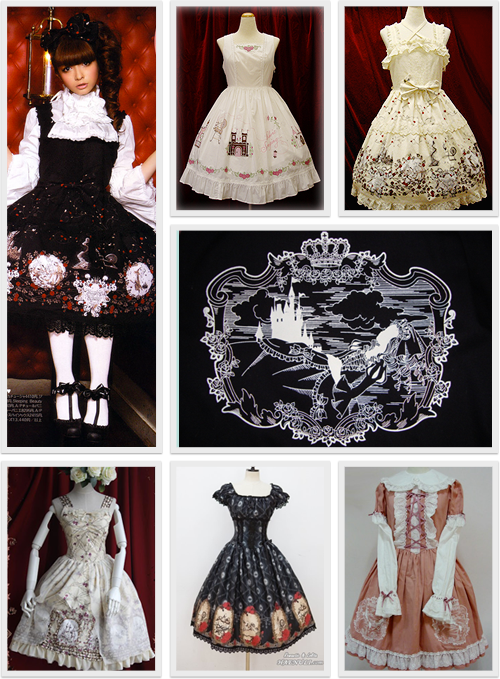
Sleeping Beauty used in lolita: Bssb, Angelic Pretty, Hanuli and Infanta
Sleeping Beauty in other media
As seen above,
Sleeping beauty has been used in lolita several times by differnt brands and is a reccurent theme as many other fairytales (Juliette et Justine also made a
Rpbe de la belle au bois dormant).
You might also have heard of the ballet based on
Sleeping Beauty. The music was composed by
Tchaikovsky and the choregraphy created by
Marius Petipa. Disney's movie uses some of Tchaikovsky's music in their animated movie. The ballet is pretty famous and the part of Princess Aurora is quite a challenge for dancers, especially its
Rose adagio which is one of the most difficult variation.
Edward Burne-Jones made a several paintings based on
Sleeping beauty: "
The legend of Briar Rose". Each panel comes with a poem written by
William Morris.
Sleeping beauty is also sometimes used as a motif in fashion editorials even if it's not the most used fairytale in fashion (see below).
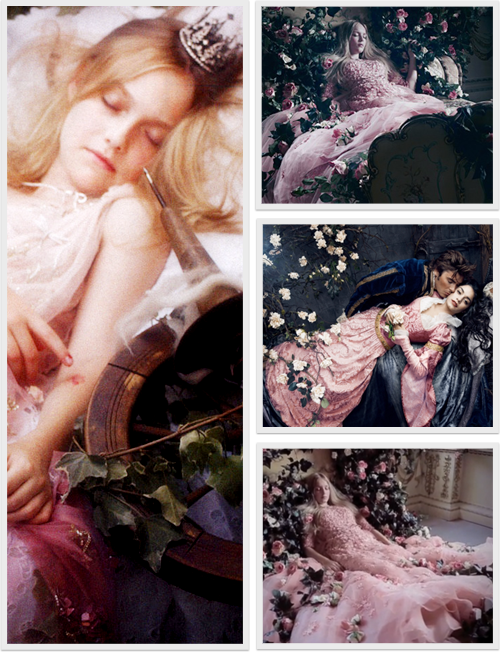
Credits: Dakota Fanning by Karl Lagerfeld, Ad for Harrods by Patrick Naik, Annie Leibovitz for Disney
Libellés : art and litterature, fairytales, fashion, lolita, music and ballet
Halo, Aureola and Glory in Art and fashion.
Halos seem to be a new trend among lolitas. I don't exactly know what was the origin of this trend. But religious themes have been used a lot in fashion editorials for quite a long time.
I decided to "research" the subject and I thought it might be interesting to share the knowledge I gathered about halos, aureolas and glories.
 Aureola / Halo
Comes from the Latin adjective
aureus which means "golden". It's usually a golden disk or circle which surrounds the head (or sometimes the whole body) of a religious figure. At first it was a pagan symbol used by the Egyptians, Greeks and Romans to symbolize divinity or spiritual power, which was later assimilated into Christian art.
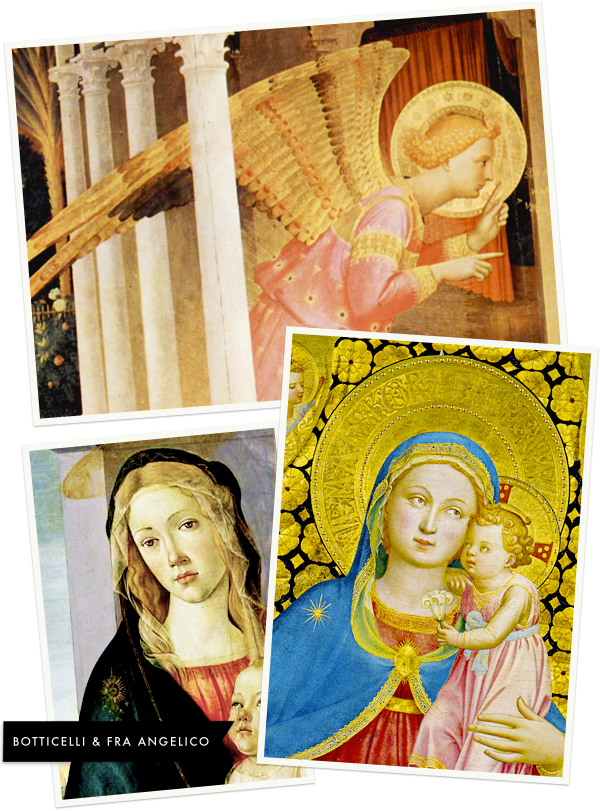
Some examples of halos used in Christian art.
You might notice that Botticelli (on the left) introduced perspective: the halo is now hovering over the heads of the saints.
Glory
Comes from the Latin adjective
gloria which means "fame". It takes the shape of rays of light surrounding the head of a saint. It's a Christian symbol it denotes the manifestation of God's presence. Glory and halos are often confused.
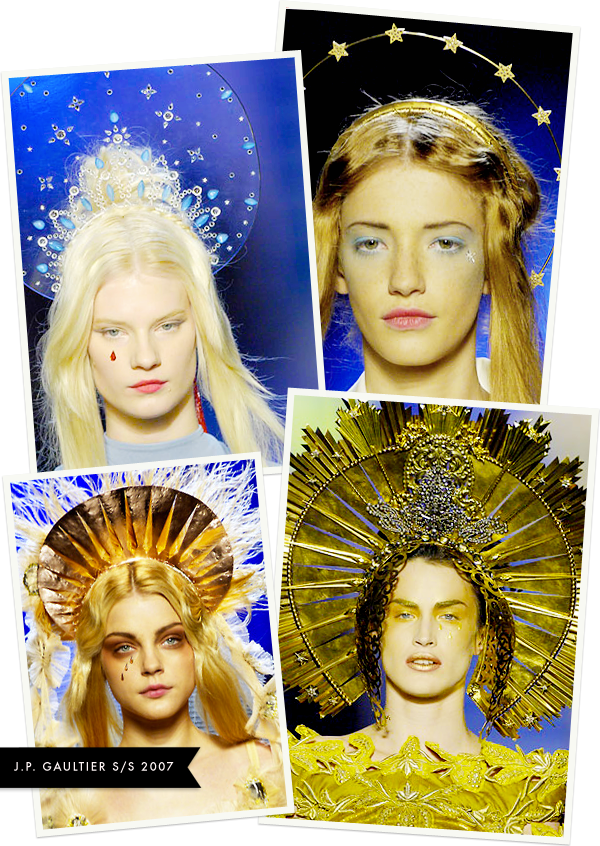
Very famous use of "Glory" and "Halos" in Fashion.
Jean Paul Gaultier's S/S 2007 collection.
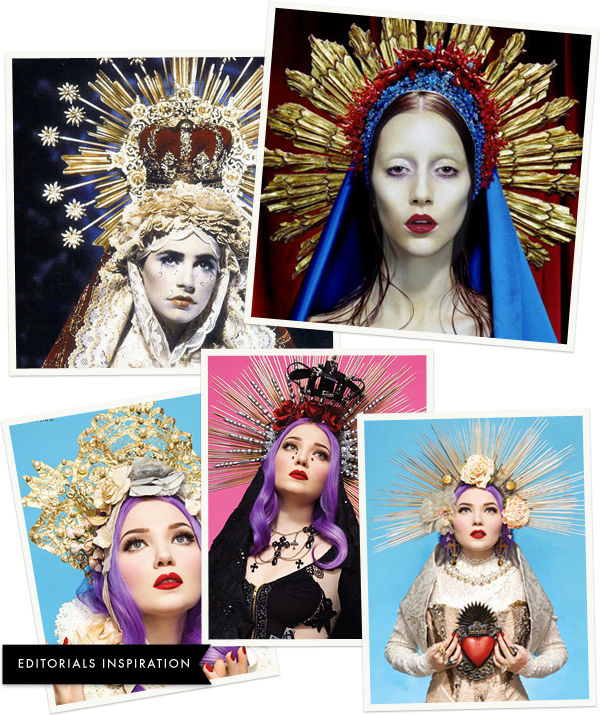
Other examples of glories and halos used in fashion editorials.
Pierre et Giles - Miles Aldridge - Jason Setiawan
So what do you think of the use of these religous symbols in fashion (lolita or not)? Do you think it's outrageous or would you wear halos, or maybe do you already have one?
Libellés : art and litterature, fashion, lolita, religion














 평화 [pʰjəŋ.hwa]
